The Carrión Building: History and Elegance of the Art Deco Lighthouse on Madrid's Gran Vía

There are buildings that occupy not only a place in the city, but also in its memory. The Carrión Building, on the most recognizable corner of Gran Vía, belongs to that rare breed of architecture that seems to condense an entire era into a single silhouette. Its sharp, luminous presence continues to mark the visual pulse of Madrid as if it were a prow frozen in time.
Built between 1931 and 1933 by Luis Martínez-Feduchi and Vicente Eced y Eced, it is in the Art Deco style and uses materials such as marble and granite. The decoration and furnishings were the work of the firm Rolaco-Mac. However, its most remarkable features for the time were the technological advances it incorporated, such as the use of Vierendell-type concrete beams, fire-resistant fabrics, and the centralized cooling system—the first in Madrid—which occupied an entire floor.
The building was conceived at a time when Madrid aspired to shed a certain nineteenth-century solemnity and embrace modernity with a bold gesture. Commissioned by Enrique Carrión, Marquis of Melín, the project resolved a challenging site with uncommon intelligence and an ambition very much of that era: to make architecture an emblem of the city. It was not simply a matter of building, but of announcing a new way of experiencing Madrid.

Architectural Features of the Carrión Building
Its architectural language, rooted in Art Deco with Expressionist echoes, speaks of an era fascinated by geometry, speed, and light. The façade, conceived as a powerful image rather than a mere enclosure, transformed the building into an instant icon. For decades, its illuminated signs further enhanced its theatrical character, making it a true urban beacon amidst the constant flow of the avenue.
Among its most outstanding features are:
Curved facade that follows the curve of the street, creating a sense of movement and dynamism.
The use of modern materials for the time, such as reinforced concrete, allowed for freer and bolder forms.
Decorative details in moldings and windows that reflect the influence of European art deco.
The Schweppes illuminated sign , dating back to 1972 , belongs to the advertising and urban aesthetic of the seventies . It was first installed in August-September of that year on the Carrión building, and since then it has become one of Madrid's most recognizable visual icons.

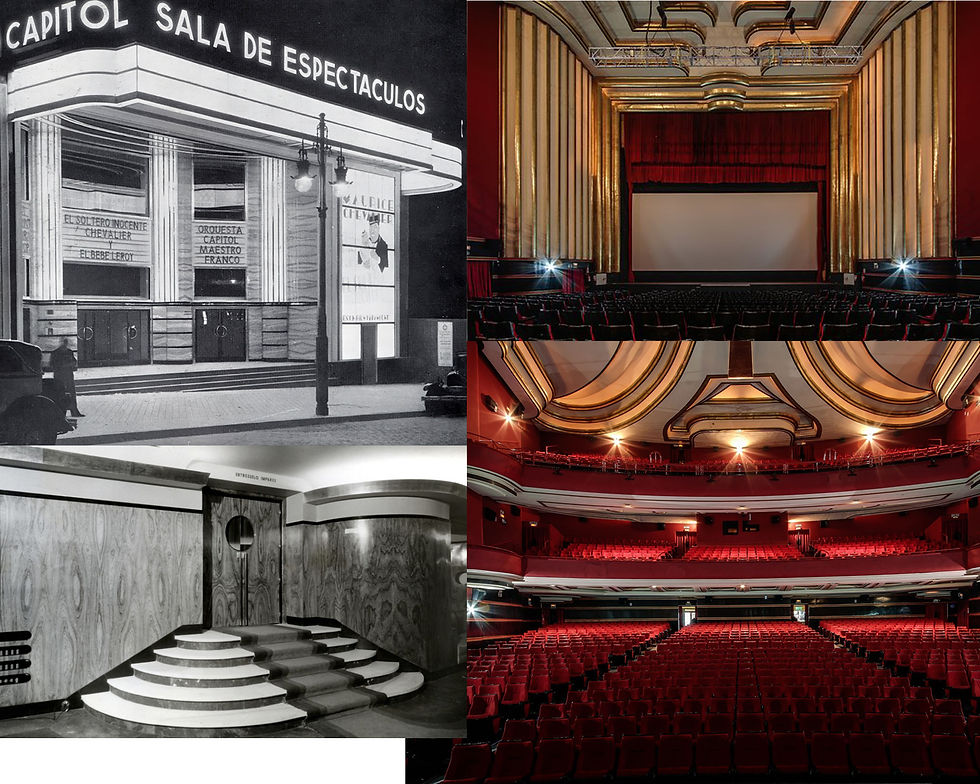
Capitol Cinema
The Capitol Cinema belongs to that class of places that don't just exist in a city, but end up shaping its very identity. On the Gran Vía, amidst the glittering signs and the ceaseless flow of pedestrians and cars, its presence has been for decades that of a stage within a stage: a facade that proclaims cinema, entertainment, and modernity.
Born in the shadow of the Carrión building, inaugurated in 1933, the Capitol was conceived as a complete urban space, where leisure, architecture, and urban life coexisted. Its history is linked to that moment when Madrid sought to emulate the great European capitals without sacrificing its own character, and found in the Gran Vía the perfect place to unfold that vision.
More than just a movie theater, the Capitol was for years a promise of wonder. There, cinema ceased to be merely a projection and became a collective experience, an urban ritual, a way to enter another light while outside the avenue continued to throb. That is why its memory lives on: because it speaks not only of architecture, but of a way of inhabiting the city, of looking up and recognizing in a corner of Madrid a symbol of its time.
The Carrión Building in Popular Culture and Tourism
Over the decades, the Carrión Building has appeared in numerous films, photographs, and works of art depicting Madrid. Its image is inseparable from the identity of the Gran Vía and, by extension, of the city itself.
For travelers, artists, and architects, this building is a source of inspiration and an example of how architecture can engage with the urban environment and history. Many tourists visit it to admire its design and to capture photographs that reflect the essence of Madrid.
In addition, the building houses commercial and cultural spaces that keep its original function alive, integrating into the daily life of the city.

Conservation and Restoration
Maintaining a historic building like the Carrión Building requires constant effort. Over the years, several restorations have been carried out to preserve its structure and original appearance.
These interventions have respected the original design, using techniques and materials that guarantee durability without losing the essence of the Art Deco style. The lighting of the Schweppes sign has also been modernized to maintain its visual impact without affecting the integrity of the building.
The preservation of the Carrión Building is an example of how architectural heritage can be protected while adapting to the current needs of the city.
The Carrión Building as an Art Deco Beacon on Madrid's Gran Vía
The term "an art deco beacon on Madrid's Gran Vía" is not just a visual metaphor. The building acts as a landmark, guiding those who walk along the avenue, especially at night when its illuminated sign shines brightly.
This lighthouse symbolizes the modernity and dynamism of Madrid in the 20th century, and it remains an emblem for those who value architecture and urban history. Its presence on the Gran Vía serves as a reminder of the importance of preserving spaces that connect the past with the present.
For architects, the Carrión Building is a living study of how the art deco style can be integrated into a complex urban environment, while for artists and travelers it is a constant source of inspiration.

Visit the Carrión Building and its surroundings
If you're planning a trip to Madrid, don't miss the chance to stroll down Gran Vía and stop in front of the Carrión Building. To make the most of your visit, consider these tips:
Observe the facade from different angles to appreciate the curve and the art deco details.
Visit at night to see the illuminated sign in all its splendor.
Explore the surrounding area , where you'll find theaters, shops, and cafes that complement the atmosphere of the place.
Check out cultural events that sometimes take place in or around the building.
This tour will allow you to understand why the Carrión Building is more than just a building: it is a living symbol of the Gran Vía and of Madrid.
The Carrión Building remains an Art Deco beacon on Madrid's Gran Vía, a meeting point of history, art, and urban life. Its bold design and enduring presence invite travelers, artists, and architects to discover an essential part of Madrid's identity. A visit here is not just about admiring a building, but about connecting with an era and a style that continue to illuminate the city. The next time you stroll down Gran Vía, look up and let this ever-shining beacon guide you.

Comments